

I Want My Daughter to Be Confident, Not Perfect—Here’s How I’m Raising Her
As a mom to a bright, curious, emotional, and sometimes wonderfully sassy 6-year-old girl, I often find myself wondering:
How do I raise her to feel confident in a world that will constantly have opinions about how she looks, behaves, speaks, learns, and even feels?
And the truth is, I don’t have all the answers.
Some days, confidence looks like my daughter proudly showing me something she has learned at school.
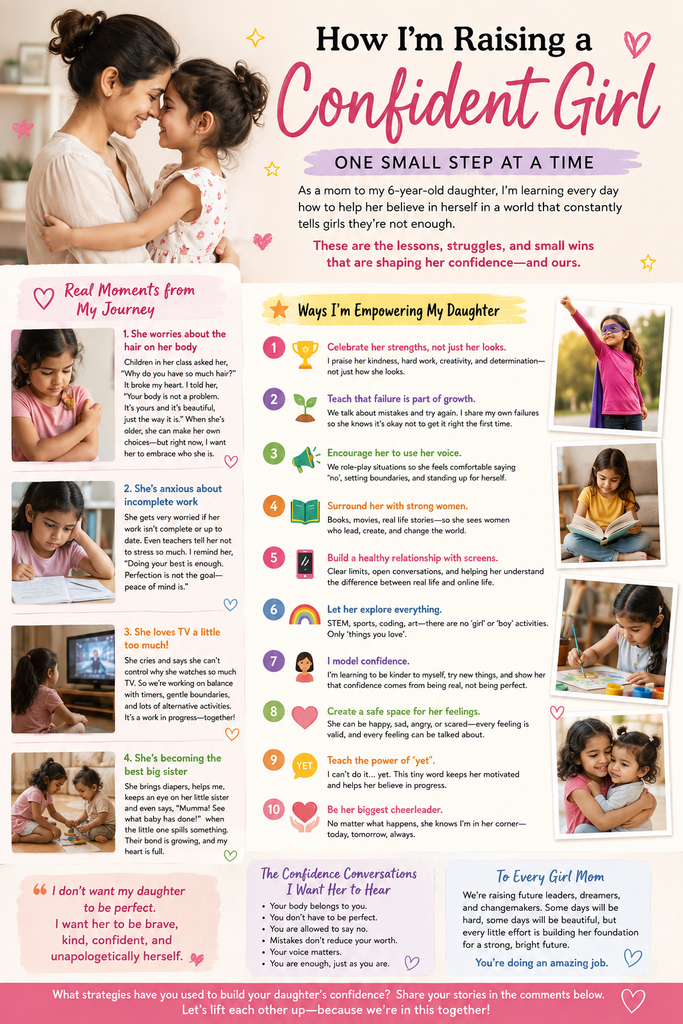
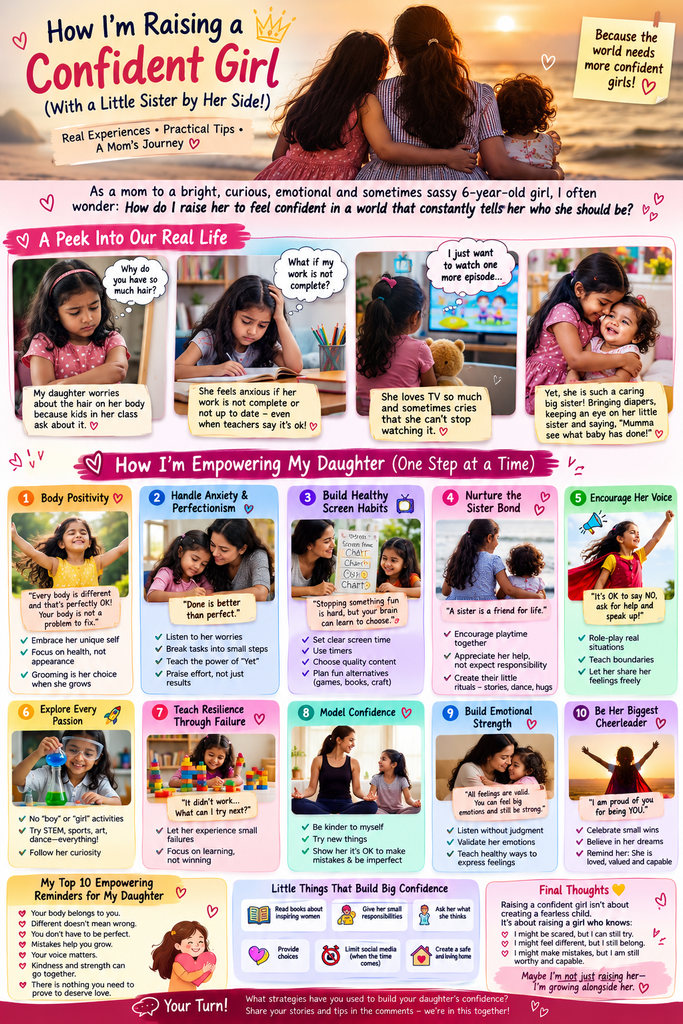
Other days, it looks like me sitting beside her while she worries about the hair on her arms because children in her class have asked, “Why do you have so much hair?”
Sometimes it means reassuring her that unfinished schoolwork is not a disaster.
Sometimes it means listening to her cry because she feels she simply cannot stop watching TV.
And sometimes confidence appears in the sweetest little moments—like watching her bring me a diaper for her 1½-year-old sister or calling out:
“Mumma! Look what the baby has done!”
when her little sister has emptied spices all over the floor.
Raising a confident girl, I’m learning, isn’t about creating a child who never feels insecure, worried, jealous, embarrassed, or afraid.
It’s about giving her the tools to deal with those feelings when they come.
And I’m learning right alongside her.
Why Confidence Matters So Much for Girls
Confidence isn’t simply teaching our daughters to look in the mirror and say, “I’m beautiful.”
It is much bigger than that.
Confidence is being able to say:
“I can try.”
“I made a mistake, but I can fix it.”
“Someone made a comment about me, but that comment does not define me.”
“I don’t know how to do this…yet.”
“I am allowed to say no.”
“I can ask for help.”
“I don’t have to be perfect to be worthy.”
As our daughters grow, they will encounter comparisons, friendship problems, academic pressure, beauty standards, social media, competition, and expectations about how girls are “supposed” to behave.
We cannot protect them from everything.
But perhaps we can give them something even more powerful:
A strong voice inside their own heads.
Here are some of the ways I’m trying to build that voice in my daughter.
1. Teach Her That Her Body Is Not a Problem to Solve
Recently, my 6-year-old daughter became very conscious about the hair on her body.
Children in her class had started asking her:
“Why do you have so much hair?”
For an adult, it might sound like an innocent childhood question.
But for a little girl who is just beginning to understand how others see her, comments like these can stay in her mind.
She started worrying about it.
And as her mom, this became an important parenting moment for me.
Instead of immediately saying that we will remove the hair when she grows older, I try first to remind her:
“There is nothing wrong with your body. Everyone’s body is different.”
Some people have more hair. Some have less. Some are tall. Some are short. Some have curly hair, straight hair, freckles, glasses, different skin tones, different body shapes—and none of those things determine someone’s worth.
When she is older, she can make her own choices about grooming if she wants to.
But right now, I want her first lesson to be:
Your body does not need to change just because somebody noticed something different about it.
What I’m trying to teach her
When another child comments on her appearance, I want her to feel comfortable saying:
“That’s just how my body is.”
And moving on.
Because confidence doesn’t mean believing you’re physically perfect.
It means knowing you don’t have to be.
2. Praise Who She Is, Not Only How She Looks
It’s almost automatic to tell our daughters:
“You look so pretty!”
And there is absolutely nothing wrong with telling our girls they are beautiful.
But I don’t want beautiful to become the most important compliment my daughter hears.
So I deliberately try to notice other things.
“That was really kind of you.”
“You worked hard on that.”
“I love how curious you are.”
“You didn’t give up even when it was difficult.”
“You were very thoughtful toward your sister.”
I want her internal definition of herself to include words like:
Brave. Kind. Funny. Creative. Smart. Curious. Persistent. Helpful.
Not simply pretty.
Try this at home
At bedtime, occasionally ask:
“What is one thing you are proud of yourself for today?”
The answer might surprise you.
3. Help Her Understand That Everything Doesn’t Have to Be Perfect
This is something we are actively working on in our home.
My daughter becomes extremely anxious when her schoolwork isn’t complete or perfectly up to date.
Sometimes even her teachers tell her:
“It’s okay. Don’t worry so much.”
But she still worries.
She wants everything finished.
Everything checked.
Everything in order.
Part of me loves how responsible she is.
But another part of me doesn’t want responsibility to slowly turn into anxiety or perfectionism.
So now, instead of simply saying:
“Don’t worry.”
I try asking:
“What exactly are you worried will happen?”
That small question sometimes helps her explain the fear hiding underneath the worry.
Maybe she thinks the teacher will be upset.
Maybe she believes everyone else has finished.
Maybe she feels that unfinished work means she hasn’t done well enough.
And that’s when I remind her:
“Your work matters, but your peace matters too.”
What I want her to learn
Being responsible is wonderful.
Being perfect is impossible.
There will be unfinished homework, missed deadlines, messy rooms, forgotten books, wrong answers and difficult days.
Confidence means knowing:
“I can handle it.”
4. Teach Her the Magic of “Yet”
Children can be incredibly quick to decide what they are capable of.
“I can’t draw this.”
“I’m bad at maths.”
“I can’t ride my bicycle.”
“I can’t do it!”
Whenever possible, I add one little word.
Yet.
“You can’t do it yet.”
It sounds tiny, but it completely changes the sentence.
“I can’t do it” sounds permanent.
“I can’t do it yet” means:
Maybe I can learn.
And that is exactly the mindset I want my daughter to carry into adulthood.
5. Let Her Fail Without Making Failure Feel Frightening
As parents, our instinct is often to rush in.
We don’t want our children to feel disappointed.
But confidence cannot grow if children never experience things going wrong.
Maybe she doesn’t win the competition.
Maybe another child gets the role she wanted.
Maybe she struggles with a subject.
Maybe her craft doesn’t look like the picture.
My job isn’t always to fix the disappointment.
Sometimes my job is simply to sit beside her and say:
“I know you’re disappointed. What do you think you could try differently next time?”
Failure doesn’t mean:
“I’m not good enough.”
It means:
“That didn’t work. What can I learn?”
6. Help Her Find Her Voice
Girls are often praised for being polite, cooperative, quiet and accommodating.
But I also want my daughter to know that being a “good girl” does not mean accepting everything quietly.
She is allowed to say:
“Please don’t take my things without asking.”
“I don’t like that.”
“Please stop.”
“No.”
“I need help.”
“That hurt my feelings.”
Sometimes we even role-play situations at home.
It feels silly.
But practising these sentences when she feels safe might make it easier to use them when I’m not around.
Because one day, I won’t be standing beside her.
Her voice will need to.
7. Help Her Build a Healthy Relationship With Screens
Here’s another very real struggle in our house:
TV.
My daughter loves watching television.
Sometimes when we ask her to stop, she becomes upset and says:
“I can’t control it. I just want to keep watching!”
My first instinct can be frustration.
Why can’t you just turn it off?
But then I remind myself—she is six.
Self-control is something children are still learning.
So instead of making TV a daily battle between parent and child, we’re working on teaching her how to manage it.
That might mean:
- deciding the viewing time before the TV goes on,
- giving a warning before screen time ends,
- using a timer,
- avoiding “just one more episode” negotiations,
- and helping her choose what she wants to do afterwards.
Most importantly, I’m trying not to label her as being “addicted” or “having no control.”
Instead, I tell her:
“Stopping something fun is difficult. But your brain can learn how.”
Empowerment here looks different
Confidence isn’t only standing on a stage.
Sometimes confidence is learning:
“I can make choices even when my brain really wants something.”
That’s a life skill she’ll need far beyond television.
8. Encourage Her to Explore Everything—Not Just “Girl Things”
Girls should grow up knowing there are no subjects, hobbies or careers that don’t belong to them.
If she wants coding, wonderful.
Football? Wonderful.
Dance? Wonderful.
Science experiments? Wonderful.
Cooking? Wonderful.
Robotics? Wonderful.
Painting? Wonderful.
I don’t want her asking:
“Is this for girls?”
I want her asking:
“Do I enjoy this?”
Expose her to sports, science, money, technology, art, music, building things, fixing things and leadership opportunities.
She doesn’t have to love all of them.
She just needs to know she’s allowed to try.
9. Teach Her That Being a Big Sister Is About Love, Not Responsibility
Watching my daughter become a big sister has shown me another side of her.
Her little sister is only 1½ years old.
And yes, having a toddler in the house means there is never a shortage of chaos.
Sometimes my older daughter brings us a diaper.
Sometimes she keeps an eye on the little one to make sure she doesn’t get hurt.
And sometimes I suddenly hear:
“Mumma! See what baby has done!”
only to discover that the little one has emptied spices, food or something else onto the floor.
These moments make me smile because I can see their relationship slowly forming.
But there’s something else I’m careful about.
I want my older daughter to help with her sister.
I don’t want her to feel responsible for her sister.
There’s an important difference.
I want to say:
“Thank you for helping me.”
rather than:
“You’re the big sister. You should take care of her.”
Her little sister is ultimately our responsibility as parents.
Their relationship should be built on love—not obligation.
10. Help the Sisters Build Their Own Bond
Instead of always asking my older daughter to “watch the baby,” I try to create little opportunities for them to enjoy each other.
They can:
- choose a bedtime book together,
- dance to one song,
- build blocks together,
- help pick the baby’s clothes,
- give each other silly nicknames,
- draw pictures together,
- or have a little “sisters only” ritual.
As the younger one grows, arguments will come too.
That’s normal.
My goal isn’t to force them to be best friends every minute.
It’s to give their relationship enough warmth that they know:
“My sister is someone who belongs in my corner.”
11. Give Her Real Responsibilities
Confidence grows when children realize:
“I can actually do things.”
So instead of doing everything for my daughter, I want to gradually give her responsibilities appropriate for her age.
She can:
- pack part of her school bag,
- put away her clothes,
- order her own food at a restaurant,
- speak to the cashier,
- choose between two options,
- help plan a family activity,
- solve small friendship problems before I intervene,
- and contribute to simple household tasks.
Whenever we constantly rescue children, we unintentionally send the message:
“You need me because you can’t handle this.”
Sometimes stepping back tells them something more powerful:
“I trust you.”
12. Introduce Her to Strong Women—Including Ordinary Ones
Yes, I want my daughter to know about women like Malala Yousafzai, Serena Williams, Kalpana Chawla, Mary Kom and other extraordinary women.
But I also want her to notice strong women around her.
Her teachers.
Doctors.
Entrepreneurs.
Scientists.
Athletes.
Her grandmother.
Her aunts.
And even her mother.
Children shouldn’t grow up believing strong women are rare superheroes.
They should grow up believing:
Strong women are everywhere.
13. Let Her See Me Being Imperfect
This might be the hardest one.
Our daughters are watching us.
If I constantly stand in front of the mirror saying:
“I look terrible.”
they hear it.
If I refuse to try something because I’m afraid of looking silly, they notice.
If I’m constantly worried about what everyone else thinks, they absorb that too.
So I’m trying to let my daughter see me learning.
Trying.
Making mistakes.
Laughing at myself.
Changing my mind.
Apologizing when I’m wrong.
And sometimes saying:
“I don’t know how to do this either. Let’s figure it out.”
Our children don’t need perfect mothers.
They need to see women who are comfortable being human.
14. Don’t Rush to Fix Every Emotion
Sometimes my daughter is angry.
Sometimes anxious.
Sometimes jealous.
Sometimes overwhelmed.
My instinct is often:
Make the feeling disappear.
But confidence isn’t never feeling uncomfortable emotions.
It’s learning that uncomfortable emotions can be survived.
Instead of immediately saying:
“Don’t cry.”
“Don’t worry.”
“It’s nothing.”
I’m trying to say:
“You look worried. Tell me what’s happening.”
Or:
“I can see why that upset you.”
Then, once she feels heard, we can talk about what to do next.
A child who knows she can trust her feelings is more likely to trust herself.
15. Teach Her That Kindness Doesn’t Mean Becoming a People-Pleaser
I want my daughter to be kind.
But I don’t want her to believe kindness means:
always saying yes,
giving up what she wants,
remaining silent,
agreeing with everyone,
or allowing other people to treat her badly.
She can be both:
Kind and assertive.
Compassionate and strong.
Helpful and boundaried.
Generous and capable of saying no.
Girls need to know that protecting their own needs doesn’t make them selfish.
16. Give Her Choices Whenever Possible
Children develop confidence by making decisions.
Not every decision, of course.
A 6-year-old doesn’t need to decide whether she goes to school.
But she can decide:
“Would you like the blue dress or the yellow one?”
“Would you rather finish homework before snack or after snack?”
“Which book should we read tonight?”
“Would you like swimming or skating this term?”
Small choices teach an important lesson:
My opinion matters.
17. Ask Her What She Thinks
One habit I want to cultivate as my daughters grow is asking questions instead of constantly giving answers.
“What do you think?”
“What would you do?”
“Why do you think she behaved that way?”
“What could you try next?”
“Do you think that was fair?”
These conversations help her develop something far more valuable than obedience:
judgment.
Because eventually she will have to make decisions when I’m nowhere nearby.
18. Be Her Cheerleader—But Also Let Her Cheer for Herself
Of course I want my daughter to know:
“Mumma believes in me.”
But ultimately, I want something even stronger.
I want her to become capable of saying:
“I believe in me.”
So instead of only saying:
“I’m so proud of you!”
sometimes I ask:
“Are you proud of yourself?”
You should see her face when she says yes.
That’s the confidence I’m hoping to build.
Not confidence that depends entirely on applause.
Confidence that comes from within.
The Confidence Conversations I Want to Have With My Daughter
As she grows, I hope these are messages she hears repeatedly:
Your body belongs to you.
Different doesn’t mean wrong.
You don’t need everybody to like you.
Being kind doesn’t mean allowing people to disrespect you.
You are allowed to change your mind.
You are allowed to ask questions.
You don’t have to be perfect.
Mistakes don’t reduce your worth.
Your appearance is only one tiny part of who you are.
You can love your sister without being responsible for parenting her.
You can enjoy screens while learning when to switch them off.
You can feel anxious and still do difficult things.
Your voice matters.
And perhaps most importantly:
There is nothing you need to prove in order to deserve love.
Final Thoughts: Maybe I’m Growing Alongside Her
I used to think raising a confident daughter meant somehow teaching her all the right lessons.
Now I’m beginning to think it’s more complicated—and more beautiful—than that.
She is teaching me too.
Her worries about her body remind me to be careful about how I speak about mine.
Her anxiety about unfinished work reminds me that perfection isn’t the goal.
Her struggle to turn off the television reminds me that self-control is something we practise, not something children magically possess.
And watching her care for her baby sister reminds me that confidence can coexist with tenderness.
Maybe raising confident girls isn’t about creating fearless daughters.
Maybe it’s about raising girls who know:
I might be scared, but I can still try.
I might feel different, but I still belong.
I might make mistakes, but I am still worthy.
I might need help, but I am still capable.
And perhaps one day, when the world tells our daughters they’re too loud, too emotional, too ambitious, too different, too much—or somehow not enough—
there will already be another voice inside them saying:
“I know who I am.”
And I can’t think of a greater gift we could give them.
Your Turn
Motherhood doesn’t come with a perfect instruction manual, and I’m learning every day.
What is your daughter struggling with right now?
Is it body image, friendships, school pressure, screen time, sibling jealousy, shyness or something completely different?
Share your experience in the comments.
Sometimes another mom doesn’t need advice.
She simply needs to read:
“We’re going through this too.”