
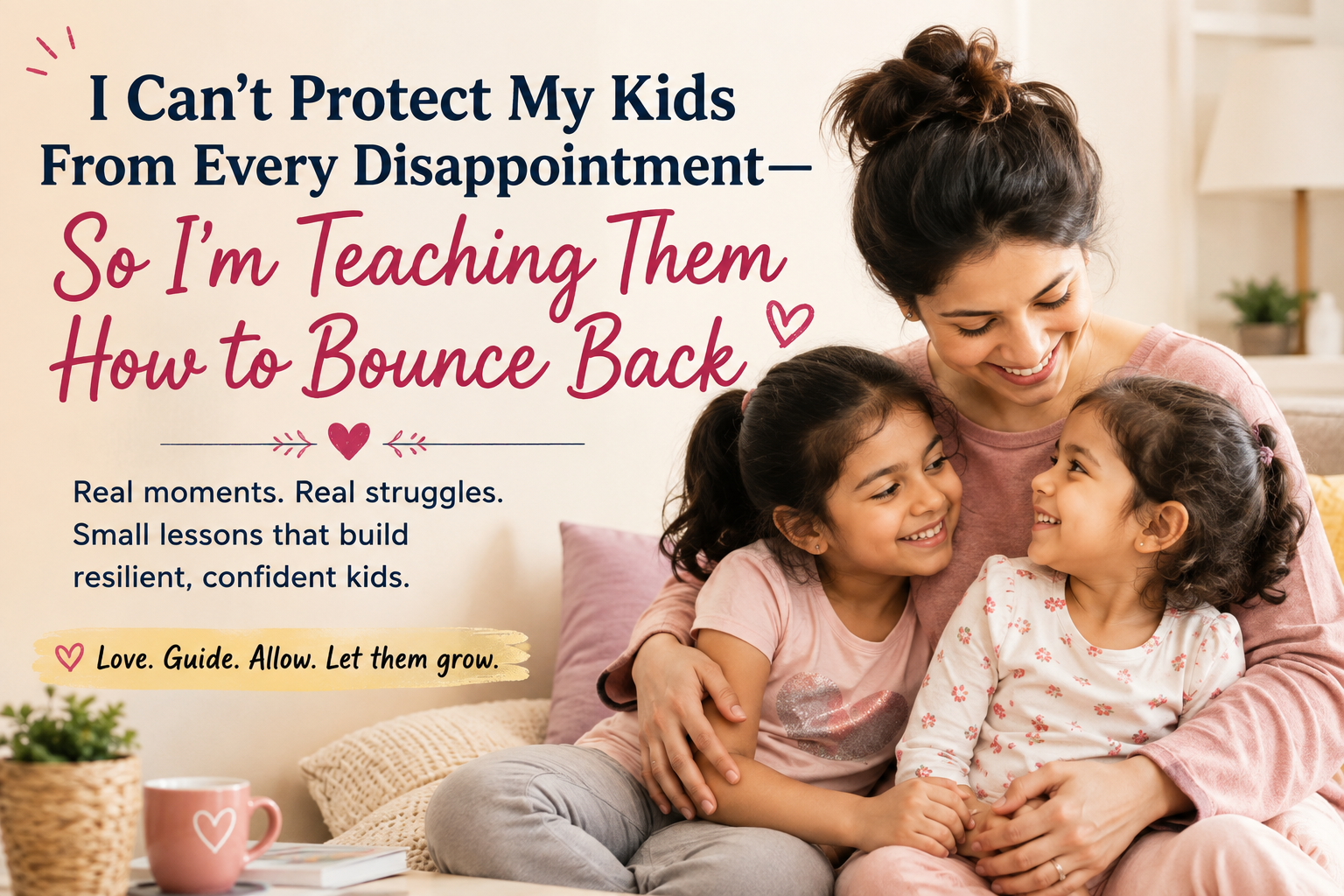
Raising a Resilient Child: What I’m Learning From My Sensitive 6-Year-Old
As a mom, one of the hardest things for me is watching my 6-year-old daughter get upset over something that, to an adult, may seem very small.
A forgotten book.
Incomplete schoolwork.
Having to get out of a swimming pool.
Turning off the television.
Losing something.
Being scared after watching something she shouldn’t have.
She is a very sensitive child, and sometimes her feelings arrive much faster than logic does.
Recently, she suddenly became convinced that she had forgotten one of her schoolbooks at home.
The tears started almost immediately.
She was worried about what would happen at school and was certain she had made a mistake.
Later, her teacher told us that the book had actually been kept in the teacher’s cupboard all along.
Nothing was wrong.
Nothing had been forgotten.
But in that moment, the fear felt completely real to my daughter.
And it reminded me of something I am slowly learning as a parent:
Resilience isn’t about teaching children not to cry.
It isn’t about telling them, “This is such a small thing. Why are you getting upset?”
It is about helping them experience disappointment, worry, mistakes and frustration—and slowly realize:
“I can handle this.”
I can’t protect my daughters from every difficult moment.
But I can help them learn how to come back from one.
And honestly, I am still learning how to do that myself.
1. First, I’m Learning Not to Treat Every Tear Like an Emergency
My daughter cries easily.
Sometimes it is because she thinks she forgot something.
Sometimes it is because her teacher may ask her to complete work she missed after being absent.
Sometimes it is simply because something didn’t happen exactly the way she expected.
My instinct is often to immediately reassure her.
“Nothing happened.”
“Don’t worry.”
“It’s okay.”
And of course reassurance matters.
But I’m realizing that instead of immediately trying to remove the emotion, I can help her understand it.
I might say:
“You’re worried because you think your book isn’t at school.”
Or:
“You’re nervous because you think your teacher might ask you to finish yesterday’s work.”
Naming the fear does something powerful.
It tells her:
Your feeling is real, but it doesn’t have to control what happens next.
Sometimes I also remind her:
“You are only six. You still have so much to learn. Everyone learns things at their own pace.”
I want her to know that being sensitive isn’t something shameful.
But I also want her to learn that every uncomfortable feeling doesn’t mean something terrible is happening.
2. Resilience Sometimes Means Getting Out of the Swimming Pool
On one vacation, my daughter absolutely refused to come out of the swimming pool.
She was having the time of her life.
Every time we asked her to come out, she became upset.
So eventually we thought:
Fine. Let her enjoy herself.
She stayed in the pool for around three hours.
And later, she became sick.
It was one of those parenting moments where the lesson came afterwards.
Sometimes we let children continue because we don’t want to deal with the tears.
Sometimes giving in feels easier than holding the boundary.
But resilience also means learning:
“I don’t always get to continue doing something just because I enjoy it.”
The next time she doesn’t want to leave the pool, I want to help her understand that disappointment is okay.
She can be unhappy about getting out.
She can complain.
She may even cry.
But she can still get out.
That’s an important distinction I’m learning:
I don’t have to eliminate the disappointment before holding the boundary.
3. I Don’t Want to Rescue Her From Every School Worry
School is another area where her sensitivity shows.
If she misses a day, she worries that the teacher will ask her to complete the unfinished work.
Sometimes her teachers themselves tell her not to worry so much.
But she still worries.
Part of me admires this because she genuinely cares about her work.
But I don’t want responsibility to turn into perfectionism.
So instead of immediately fixing everything, I’m trying to help her break the problem down.
“What work is incomplete?”
“Can you finish some of it today?”
“If you can’t finish it, what can you tell your teacher?”
The goal isn’t for her to stop caring.
It’s for her to learn:
Incomplete does not mean disaster.
There will be unfinished work throughout life.
Missed deadlines.
Mistakes.
Days when we aren’t our best.
Resilience is knowing that one incomplete page does not define you.
4. Screen Time Has Become One of Our Biggest Resilience Lessons
This is probably one of our most honest parenting struggles.
My daughter loves television.
And yes, sometimes I let her watch because I also need some time for myself.
I think many parents will understand this.
Screen time can buy you twenty quiet minutes to cook, work, sit down, or simply exist without somebody calling “Mumma!”
But the problem begins when it’s time to stop.
My daughter can become extremely emotional when we turn off the television.
She also likes watching short videos, which we try to discourage.
And sometimes she comes across scary or horror-related content.
Then the consequences arrive at bedtime.
She becomes afraid to stay alone in the room.
If we’re busy doing something else, she wants someone nearby.
Sometimes she even asks somebody to accompany her to the toilet because she is frightened.
So screen time in our house is no longer simply:
“How many minutes should a child watch TV?”
It’s also about teaching her:
What we watch affects how we feel.
We’re trying to talk more about choosing content, avoiding frightening videos, and learning how to stop even when she wants another video.
And I’m trying to remind myself that if I use the screen because I need a break, that’s okay too.
The goal isn’t perfect parenting.
The goal is creating healthier habits little by little.
5. Sometimes I Have to Let Her Struggle Before Helping
One thing I’ve noticed as she grows is how many little skills she has learned simply because she kept trying.
She used to write some letters and words in mirror form.
Now she has improved.
Her maths has become much better.
She can read small sentences.
Her writing has improved.
And recently I noticed another tiny milestone that probably wouldn’t make it into any parenting book:
She can now take leggings or other clothes that are turned inside out and straighten them herself before wearing them.
It sounds like such a small thing.
But that’s exactly how independence develops.
Children struggle.
We show them.
They try.
They get annoyed.
They try again.
And one day they suddenly don’t need us for that thing anymore.
Sometimes resilience doesn’t look dramatic.
Sometimes it looks like a six-year-old sitting on the floor figuring out how to turn her leggings the right way around.
6. We Don’t Always Let Her Win
Board games are a small but surprisingly useful way to teach children about disappointment.
My daughter likes winning.
Of course she does.
But we don’t deliberately let her win every time.
Sometimes she wins.
Sometimes we win.
And usually, she handles losing reasonably well.
I think that’s important.
If children always win because adults are afraid they’ll get upset, they never get the chance to experience that small feeling of disappointment.
I’d rather she learn it safely at home over a board game:
“I lost this round, and I’m still okay.”
Sometimes I might say:
“You didn’t win this time. Want to play again?”
That little again is where resilience starts.
7. Her Little Sister Is Teaching Her Resilience Too
My younger daughter is only about 1½ years old, which means she is naturally very good at creating chaos.
She spills things.
She grabs things.
She scribbles.
She occasionally breaks her big sister’s toys.
And I’ve noticed something beautiful about my older daughter.
If her sister breaks a toy, she doesn’t usually become extremely upset.
Instead, she often says:
“We can fix it.”
And then she tries.
That small sentence makes me happy every time I hear it.
Because isn’t that resilience in its simplest form?
Something broke.
Let’s see if we can fix it.
She is less patient when her little sister scribbles on her schoolbooks—and honestly, I understand that!
If she’s drawing and the baby comes near, she’ll move the drawing away to protect it.
That’s also something I want her to learn:
Resilience doesn’t mean allowing people to ruin your things.
She can love her sister and still protect her boundaries.
She can say:
“Don’t draw on my book.”
Being patient and standing up for yourself can exist together.
8. Children Learn Resilience From Watching Adults Make Mistakes
One day, I baked a cake and completely forgot the sugar.
My daughter had been helping me in the kitchen.
When we realised what had happened, she actually said sorry because she hadn’t read the ingredients properly either.
But I didn’t want her to carry that responsibility.
It wasn’t some huge disaster.
We had made a cake without sugar.
That’s all.
And now it has become one of those family stories we remember.
There’s another running joke in our house about the time one of her aunts accidentally broke a fragile piece of crockery.
We still sometimes say:
“Remember when aunty broke that fragile thing?”
And that’s actually useful.
Children need to see adults break things.
Forget things.
Burn things.
Get things wrong.
Because if adults appear perfect, children may start thinking mistakes are something only they make.
Sometimes the healthiest response is simply:
“Oops. That went wrong.”
Then we clean it up and continue.
9. I’m Also Learning to Apologize When I Lose My Patience
Our mornings are not always peaceful.
Getting ready for school can become a daily battle.
Sometimes my daughter doesn’t want to go.
She complains.
She delays.
And honestly, I am not exactly bursting with energy every morning either.
After repeating the same instructions and dealing with the same resistance, I sometimes lose my patience and shout.
Then later, I regret it.
I’m learning that resilience isn’t something I only have to teach my daughter.
I have to model it too.
That means saying:
“I was frustrated this morning, but I shouldn’t have shouted like that.”
Apologizing to children doesn’t make parents weak.
It shows them something valuable:
Relationships can recover after difficult moments.
You can make a mistake, take responsibility, repair it and move forward.
That may be one of the most important lessons we can teach.
10. I Want Her to Know That One Failure Does Not Define Her
This is probably the biggest lesson I want both of my daughters to carry through life.
One failure does not define your life.
Maybe you aren’t good at one subject.
Maybe you don’t win the competition.
Maybe you aren’t selected for something.
Maybe your friendship doesn’t work out.
Maybe you make a mistake that feels enormous.
That does not mean you are a failure.
You might struggle in one area and excel in another.
You may fail today and succeed later.
You may discover something completely different that you’re wonderful at.
I want my daughters to understand:
Don’t let one difficult moment decide what you believe about yourself.
Life is too big for that.
11. Sometimes Resilience Means Saying, “This Happens”
One of the things I often say to my daughter when she is upset is:
“This happens.”
Then I remind her:
“You’re only six. You have a lot to learn. Everyone learns at their own pace.”
As adults, we know that forgotten books happen.
Mistakes happen.
Broken toys happen.
Bad days happen.
We lose games.
Plans change.
Things don’t always go our way.
But children are experiencing many of these disappointments for the first time.
Something that feels ordinary to us can feel enormous to them.
So instead of saying:
“It’s nothing.”
Maybe we can say:
“It feels big right now, but you will get through it.”
That’s the message I want my daughter to eventually carry inside herself.
The Resilience Phrases I Want My Daughters to Grow Up Hearing
There are a few messages I want to repeat so often that someday they become their own inner voice:
This happens.
You can try again.
You don’t have to be perfect.
You are allowed to be disappointed.
You can be scared and still do something.
You can ask for help.
You can fix some mistakes.
Some things cannot be fixed, and you can still move forward.
You don’t have to win every time.
Everyone learns at their own pace.
And above all:
One failure does not define your life.
Final Thoughts: Maybe Resilience Looks Different in a Sensitive Child
I used to think resilient children were the ones who didn’t cry easily.
Now I’m not so sure.
Maybe resilience isn’t about crying less.
Maybe it’s crying because you think you’ve forgotten your schoolbook—and then walking into class anyway.
Maybe it’s being upset about leaving the swimming pool—and learning that sometimes Mom still means it’s time to get out.
Maybe it’s losing a board game and playing another round.
Maybe it’s watching your little sister break a toy and saying:
“We can fix it.”
Maybe it’s being scared at night after watching something frightening and eventually learning how to make better choices about what you watch.
Maybe it’s turning a piece of clothing the right way around after struggling with it ten times.
These are small moments.
But childhood is made of small moments.
And perhaps each one is quietly teaching my daughter:
Something can go wrong, and I can still be okay.
That’s what I want resilience to mean in our home.
Not toughness.
Not hiding emotions.
Not pretending nothing hurts.
But knowing that disappointment, mistakes and difficult feelings are part of life—and none of them get the final word.
Your Turn
Do you have a sensitive child who worries deeply about small things?
How do you help your child deal with disappointment, mistakes, screen-time battles or fear without immediately fixing everything for them?
I’d love to hear what works in your home.
Because sometimes the most reassuring thing another parent can hear is:
“Yes, this happens in our house too.”